Belgium will once again hold the annual cyclist sprinters’ classic ‘In Flanders Fields – from Middelkerke to Wevelgem.’
Formerly the Gent-Wevelgem, the course stretches over 240km of former Western Front battlefields with the climactic part of the race being the ascent of the Kemmelberg.
Faced with a 23% gradient at its steepest section and a summit of 154m above sea level, the Kemmelberg is a short but sharp hill overlooking Flanders’ fields.
During the Great War, this gave the Kemmelberg a strategic significance as an important lookout for the Allies, and would make it a place of intense fighting during the German Spring Offensive of 1918.
Following the failure of Operation Michael to bring a decisive outcome in the Somme, German commander Erich Ludendorff focused his attention on the Flanders – Lys region, desiring to take Hazebrouck and force the Allies out of Ypres, and back to the Channel ports.
Named Operation Georgette, the attack was launched on 7 April 1918.
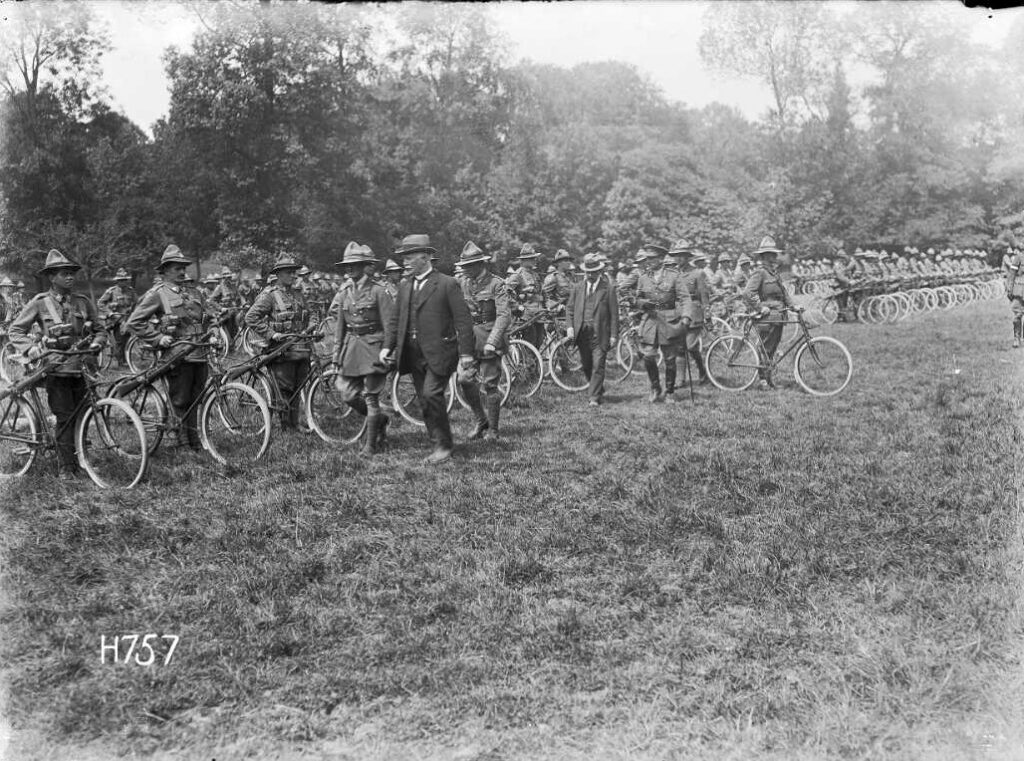
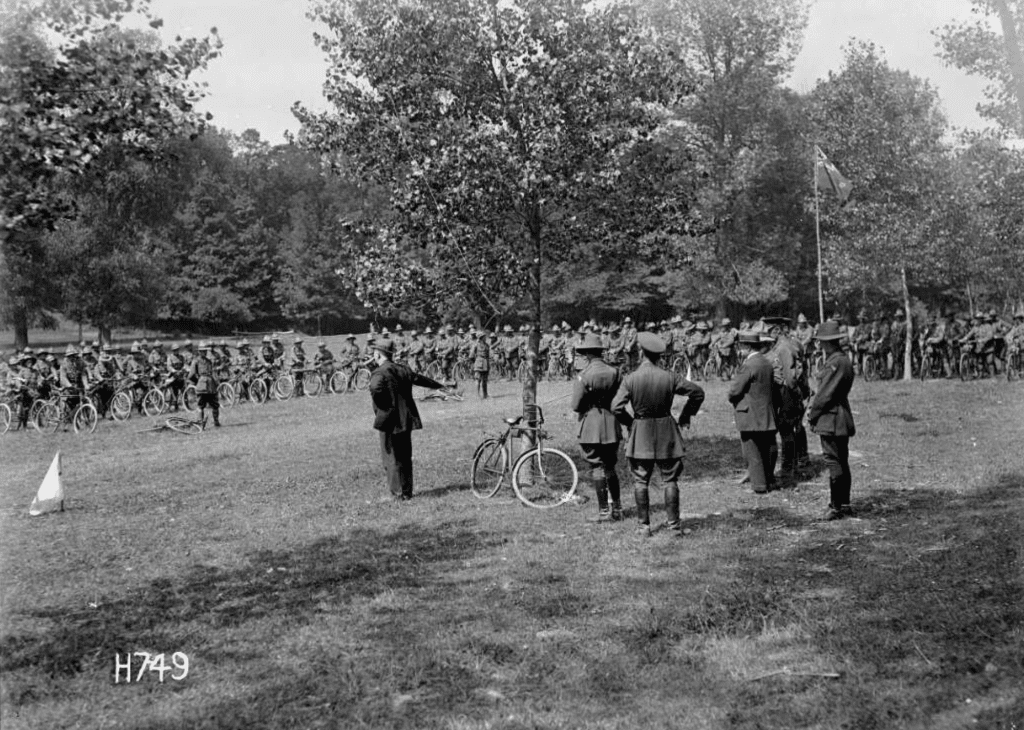
Prime Minister William Massey inspects the NZCC at Oissy, 3 July 1918. Alexander Turnbull Library (1/2-013358-G).
Two years earlier, the New Zealand Cyclist Corps (NZCC) was formed out of men training to be mounted riflemen. At the start of Operation Georgette, this mobile unit had been hard at work laying cables through Allied trenches.
News of the German attack forced the Cyclists to reorganise into a battle-ready state.
Come 11 April 1918, the increasing cannonades near Armentières told of an oncoming German advance, with enemy troops setting up positions on the southeastern slopes of the Kemmelberg.
On 15 April 1918, the Germans made considerable progress on the Kiwis’ right flank, and the frontline continued to advance in favour of the Germans.
The NZCC was relieved from the hill on 16 April 1918, but not before they came under surprise shelling and machine gun fire at Donegal Farm, leading to the loss of two men.
The two Cyclist Companies returned to the slopes of the Kemmelberg on 17 April 1918 where they again came under heavy German attack. Shelling was “most intense, every sort of gun and gas shell was used.” The Germans were repulsed, but the Kiwis lost seven men and many more were wounded.
Military Medals were awarded to each of Lance Sergeant W.T.N Bond, and Corporal W.H. Whiting for “bravery in action and devotion to duty.”
Relieved on 18 April 1918, the Kiwis would not return to the Kemmelberg which fell to the Germans eight days later. Instead, they would attempt to stop a gap in the lines near Vierstratt, coming under “awful shelling” and being harassed by the German Airforce which was “peppering them with their machine guns.”
Operation Georgette, despite advancing 15km into Allied lines, would eventually be called off by the Germans on 29 April 1918 as casualties mounted and the desired victory was not achieved.
Now, over 100 years later, the slopes of the Kemmelberg are once again covered in trees and life, and today’s professional cyclists are getting ready to face the daunting sprint up the sharp slopes that were once covered in trenches, barbed wire and mud.
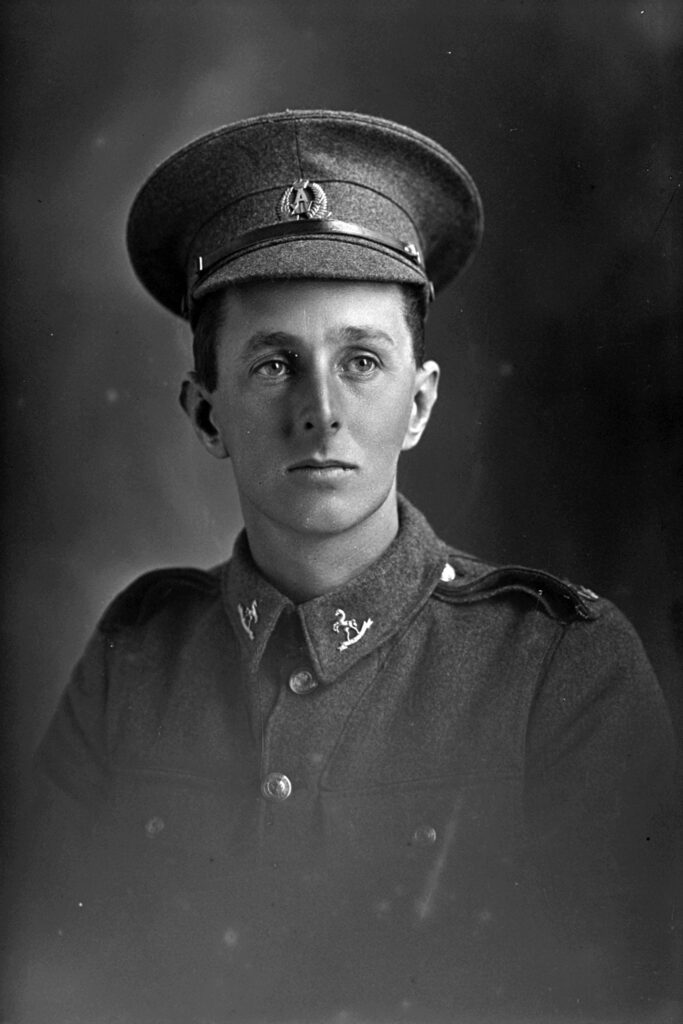
Private Charles Carrington Southey, 1916, photograph by Herman Schmidt. Sir George Grey Special Collections, Auckland Libraries (31-S2531).
The story of the New Zealand Cyclist Corps, while not known widely in Aotearoa, is certainly not forgotten.
During the centenary period, the Ministry of Foreign Affairs and Trade, Cycling New Zealand, the organisers of the then Gent-Wevelgem race, and local authorities worked together to produce a living memorial to the men of the NZCC.
During a ceremony attended by Elizabeth Southey, daughter of Charles Southey who served with the NZCC, the local mayor unearthed one of the famous cobblestones from the road up the Kemmelberg.
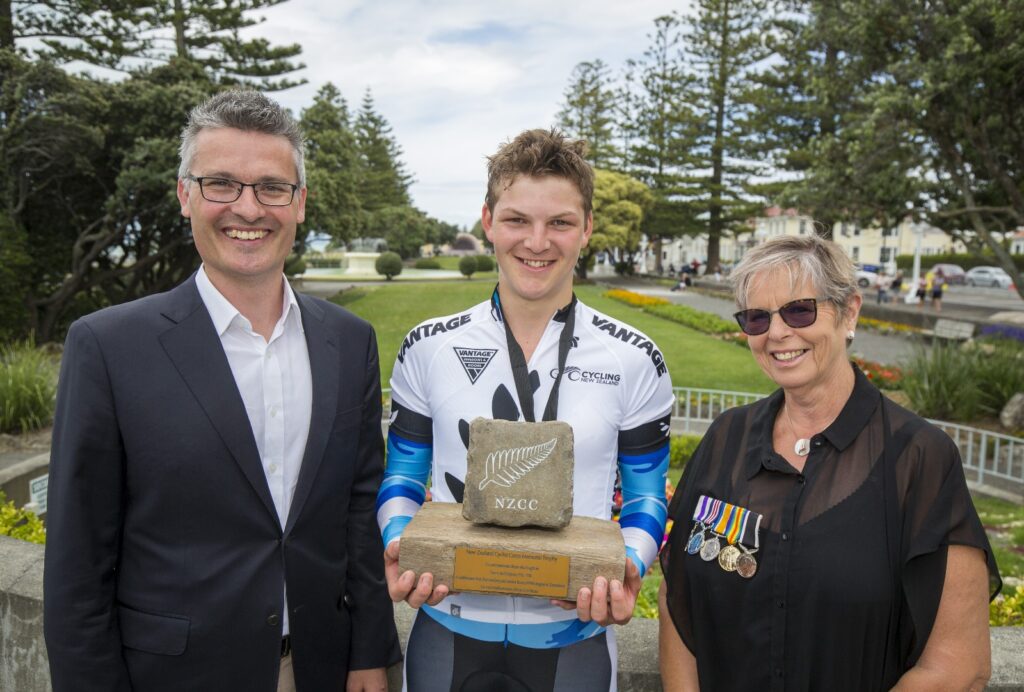
This stone was mounted on a plaque, creating a truly unique trophy which is presented annually to the NZ Under 23 Road Cycling Champion.
The trophy was first awarded in 2018 to coincide with the centenary of the NZCC’s battle on the Kemmelberg.
This trophy fittingly goes to the Under 23 Champion: many of the men of the NZCC were around the age of 23 during the time of the Great War.
In 2018, Cycling New Zealand Participated in many of the Flemish Classics, with the Under 23 Men’s Cycling Team racing the Gent – Wevelgem. For this special race held during the centenary of the final year of World War 1, the team donned a commemorative jersey that held the names of the 708 members of the New Zealand Cyclist Corps.
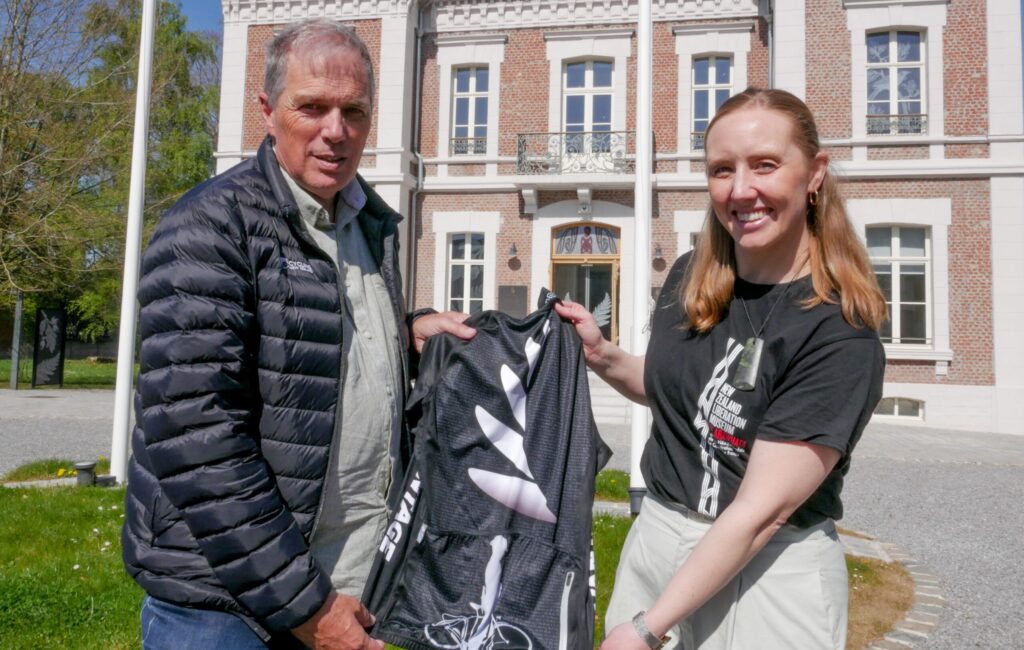
One of these jerseys was gifted to Te Arawhata and is currently on display as part of the Museum’s temporary exhibition Ça Roule – Remembering the New Zealand Cyclist Corps. This interactive exhibition follows the tracks of the NZCC, including their involvement in Flanders, the Spring Offensive and the Advance to Victory of 1918.
Inaugural winner of the New Zealand Cyclist Corps Memorial Trophy, Sam Fouche, with Roger Dungan and Elizabeth Southey, daughter of NZCC member Private Charles Carrington Southey, Napier, New Zealand, January 2018. Image courtesy of Cycling New Zealand.
Graeme Hunn, Cycling NZ’s former Pathway Lead, stated it was a privilege to share a piece of cycling history with Te Arawhata.
“The museum is such a special place for New Zealanders and a reminder of the sacrifices of the past. The design of the jersey links the next generation of New Zealand cyclists with those who fought so bravely on these lands.
“To be able to contribute to the exhibition, telling the story of the New Zealand Cyclist Corps, is an honour.”
Graeme Hunn, Cycling New Zealand and Elizabeth Wratislav, New Zealand Liberation Museum - Te Arawhata.